
Cuban chains are one of the most widely recognized chain families in the jewelry market. Larger sizes are frequently used for men’s necklaces and bracelets, while slimmer versions can work across women’s, men’s and unisex collections. Bold chains are also closely connected with hip-hop jewelry and performer style, a relationship documented in exhibitions such as the American Museum of Natural History’s Ice Cold: An Exhibition of Hip-Hop Jewelry.
For a professional buyer, however, the term “Cuban chain styles” is not a complete specification.
Two chains can have the same width and length but still look very different. The difference may come from the surface profile, link density, wire diameter or the way the links are connected. If these details are not confirmed before sampling or ordering, the supplier’s interpretation may not match the buyer’s reference.
This guide turns more than ten years of factory experience into a practical identification method. It focuses only on style and visible structure. Materials, plating and production quality will be covered in the next article in this series.
The Five Details a Professional Buyer Should Confirm
Before requesting a sample or quotation, identify these five points:
- Width and length
- Surface profile
- Link density
- Link construction
- Link pattern
This sequence is useful because it moves from basic measurements to the details that most often cause visual differences.
1. Start With Width and Length
Width and length are the two easiest specifications to communicate, but they do not define the complete chain style.
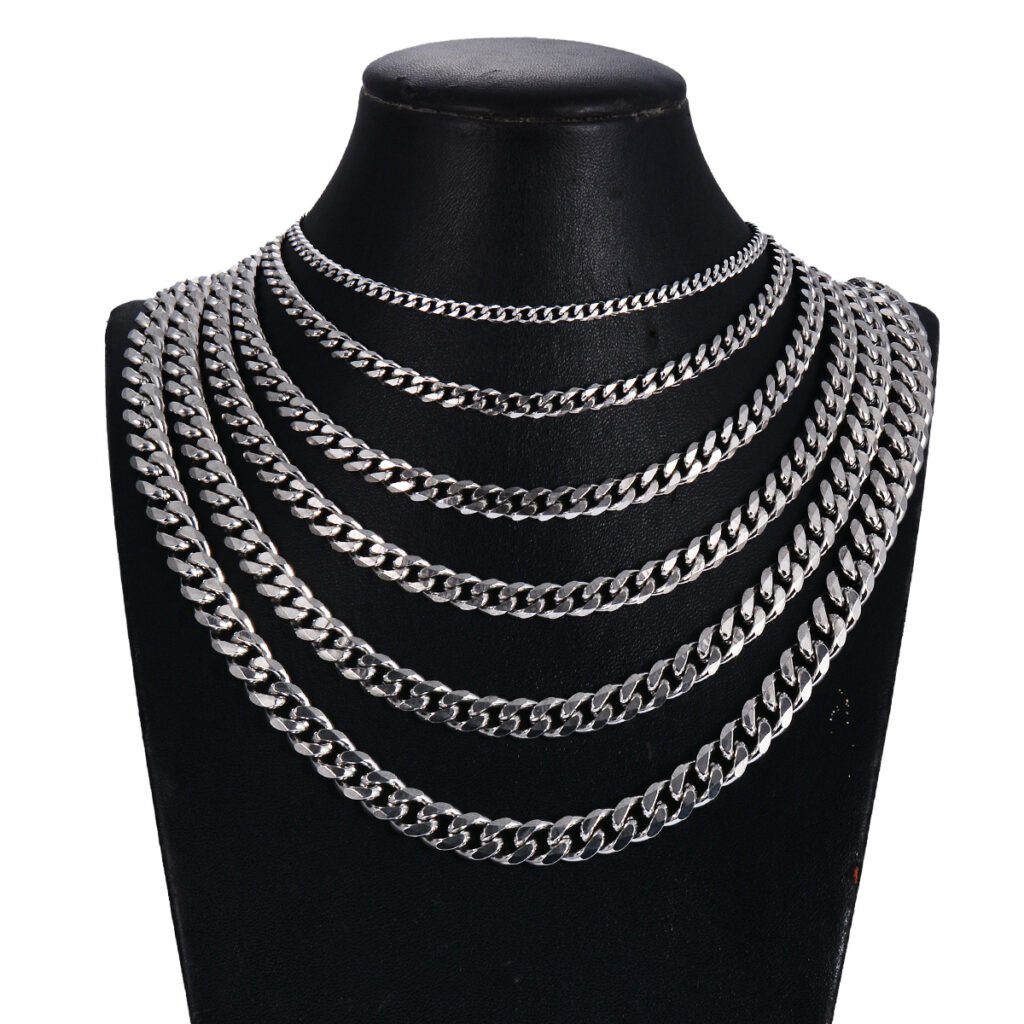
Cuban Chain Width
Cuban chains can range from approximately 2 mm to 25 mm in width. In our factory experience, 3 mm to 10 mm is the most frequently requested commercial range.
- 3–6 mm: often selected for women’s styles and lighter unisex designs
- 6–10 mm: often selected for men’s styles and stronger statement pieces
- Around 6 mm: a practical crossover size used in both categories
- Above 10 mm: usually chosen when the design needs a more substantial visual presence
These are market tendencies, not fixed gender rules. The target customer, product positioning and local market should always guide the final choice.
Common Bracelet and Necklace Lengths
For bracelets, the usual range is approximately 17–22 cm. The most frequently requested lengths are 18 cm and 19 cm.
For necklaces, the usual range is approximately 40–70 cm. Common commercial lengths include 45 cm, 50 cm and 55 cm.
A buyer should also confirm how the supplier measures the finished length and whether the clasp is included. A small difference in measuring method can affect the final fit.
2. Identify the Surface Profile
This is the most important visual classification in this guide.
Consumers may describe a Cuban chain as rounded, flat, square or diamond-shaped. Factories usually identify the difference by looking at which surfaces have been ground flat and which surfaces remain curved.
Terminology is not completely standardized across countries and suppliers. For accurate sourcing, use the factory name together with a reference photo and a description of the visible geometry.
Rounded-Face Cuban Chain
A rounded-face Cuban chain has a smooth curved grinding surface on the visible face of each link. The transition is soft, without a large flat top or sharply beveled outline.
How to recognize it: Look at the highlight on the front of the link. A rounded surface produces a softer, narrower reflection that moves gradually across the curve.
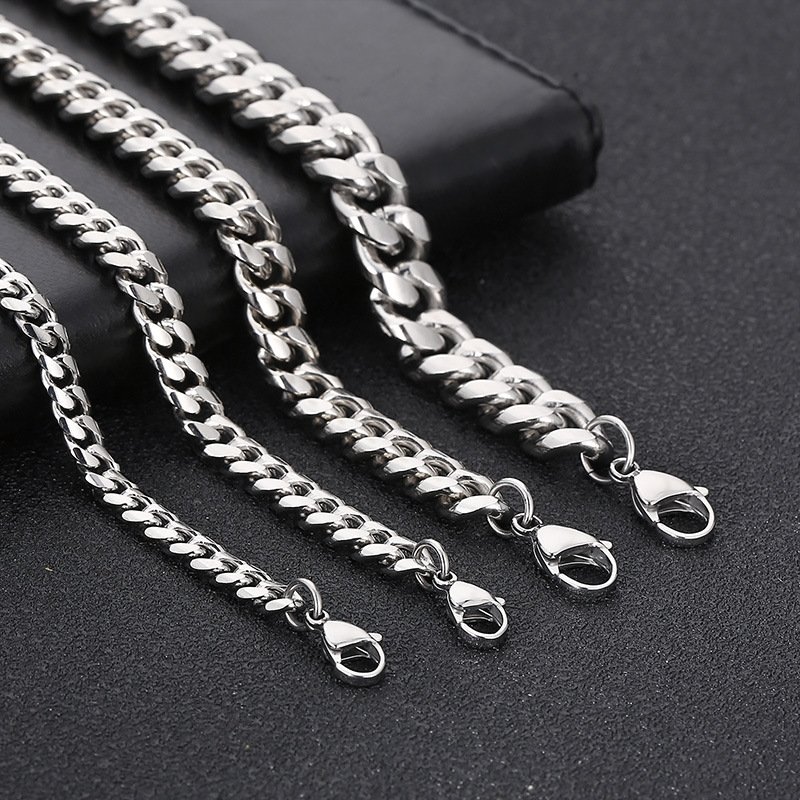
Rounded-face Cuban chains keep a smooth curved surface across different widths.
Two-Side-Ground Cuban Chain
In factory terminology, a two-side-ground chain has its front and back faces ground flat. The outer sides keep more of the original curved profile.
How to recognize it: The visible face looks flatter and reflects light in a broader area, while the outside edges still look rounded.
The front and back are flat, while the outer sides retain a curved profile.
Four-Side-Ground Cuban Chain
A four-side-ground chain is ground into flat surfaces in four directions. Compared with the two-side-ground version, its overall profile looks more squared and less rounded.
How to recognize it: Check both the broad face and the outside edge. If both areas show clear flat reflections, the chain is closer to a four-side-ground profile.
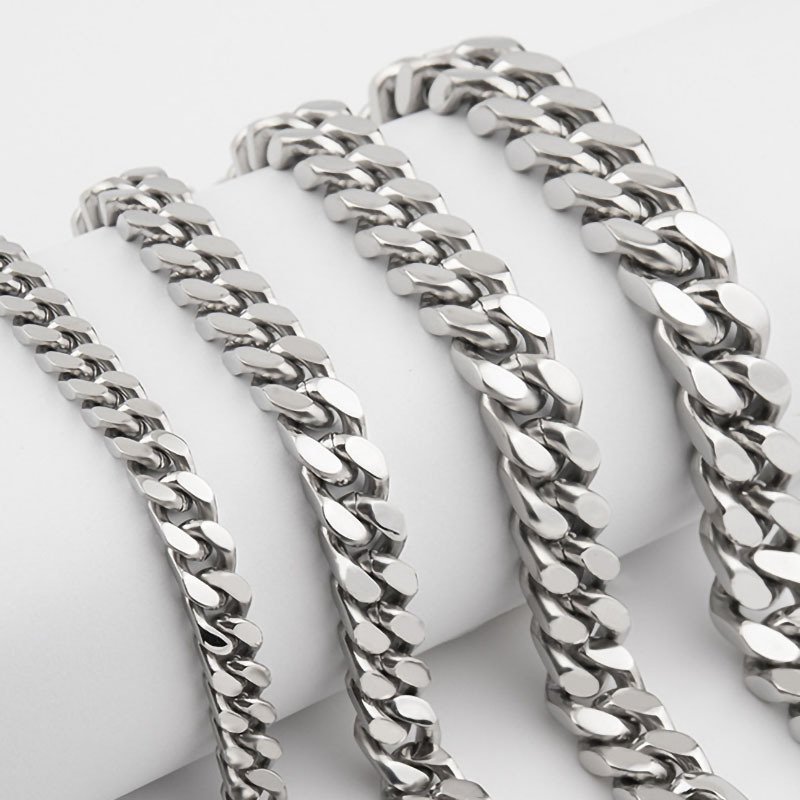
Four flat directions create a more squared visual profile.
Six-Side-Ground Cuban Chain
A six-side-ground Cuban chain has flat front and back faces plus beveled surfaces along both sides. These angled surfaces create a diamond-like outline and stronger changes in reflection.
This is a very popular profile in our market experience because the bevels give the chain a sharper and more dimensional appearance.
How to recognize it: Look for repeated diagonal highlights along the sides. A four-side-ground chain looks more square, while a six-side-ground chain looks more beveled or diamond-shaped.
Flat faces and beveled sides give the six-side-ground Cuban chain its diamond-like profile.
Quick Surface Comparison
| Factory classification | Front/back appearance | Side appearance | Overall visual profile |
|---|---|---|---|
| Rounded-face | Curved | Curved | Soft and rounded |
| Two-side-ground | Flat | Mainly curved | Flat face with rounded edges |
| Four-side-ground | Flat | Flat | More square |
| Six-side-ground | Flat | Beveled into additional planes | Angular and diamond-like |
3. Check the Link Density
Link density is a separate specification from width.
Two chains can both be 8 mm wide but use different wire diameters or link proportions. This changes the amount of open space between links and creates either a looser or denser appearance.
For a buyer, this difference affects more than appearance. It can also change the chain’s visual weight, hand feel and product positioning. That is why “8 mm Cuban chain” is still not a complete request.
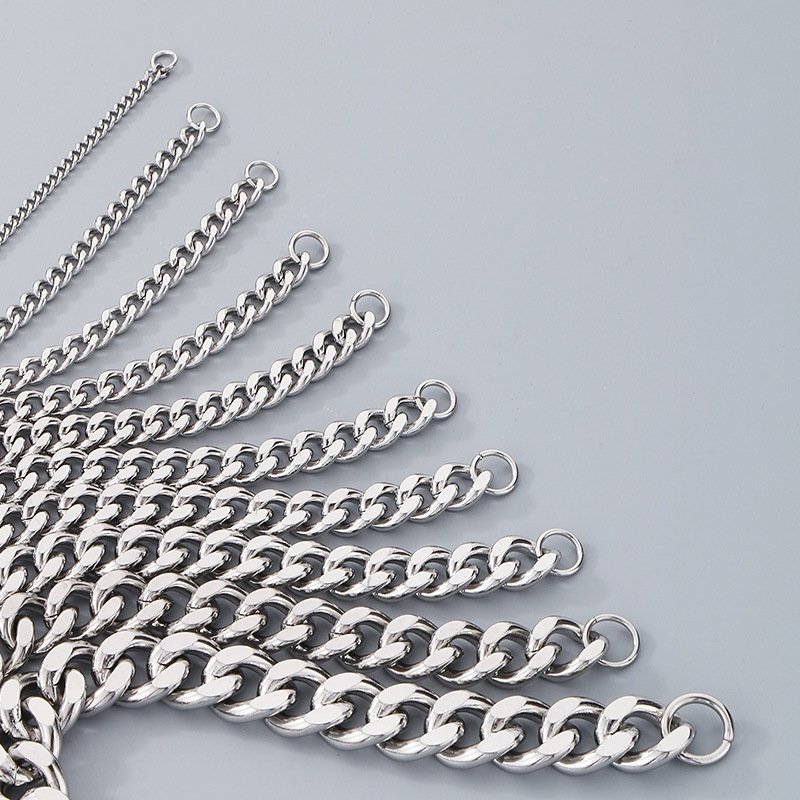
A More Open NK Chain
In our factory terminology, an NK chain is a common Cuban-style variation with a relatively flat and open structure. It is usually a more cost-focused option than denser Cuban constructions.
“NK” is not a universally standardized retail term. When sourcing from a new supplier, send a photo and describe the chain as flat, open and uniform instead of relying only on the letters “NK.”
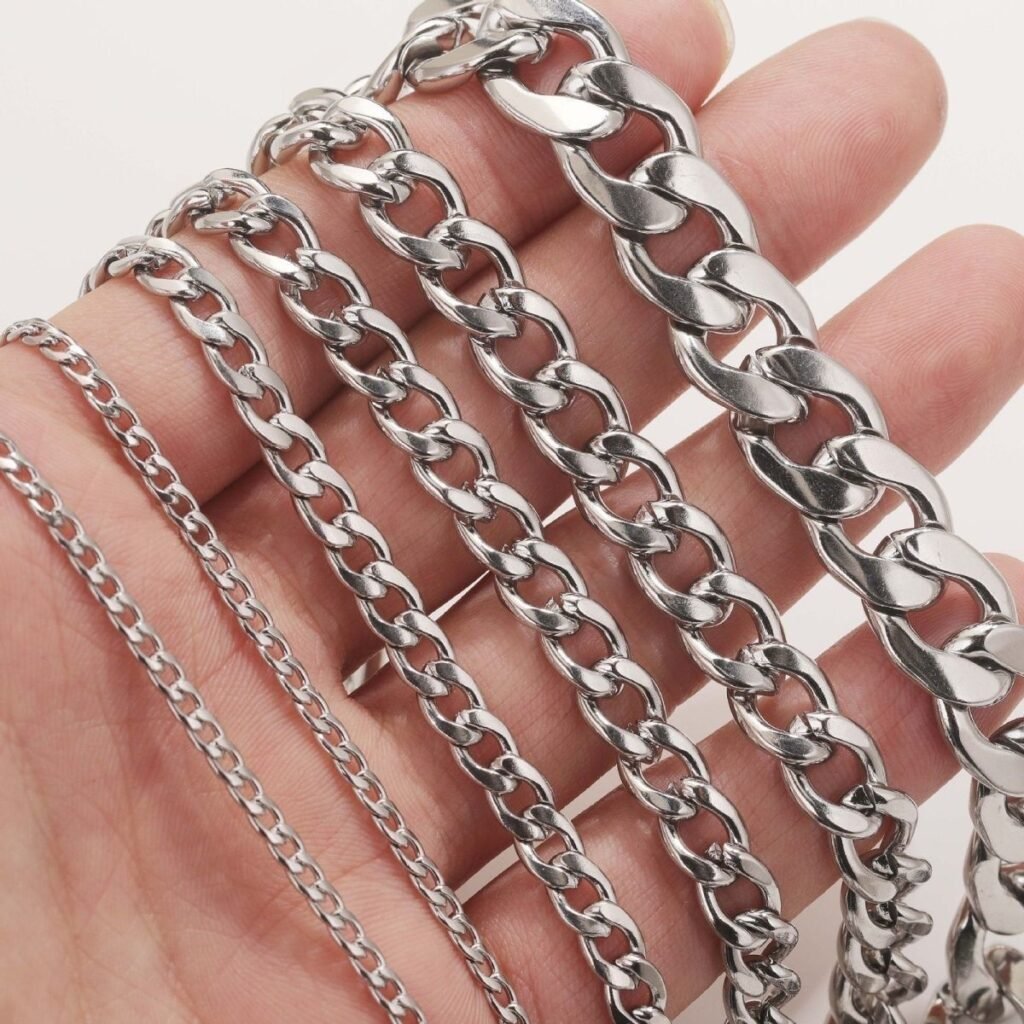
NK chains show a relatively flat, open structure across several widths.
A Denser NK Variation
The same basic NK style can be produced with a denser visual arrangement. In the example below, the spaces between the links are smaller. The links also include a visible embossed texture.
This article uses the image to explain density and visible style only. The embossing method and production process belong to the next article in this series.
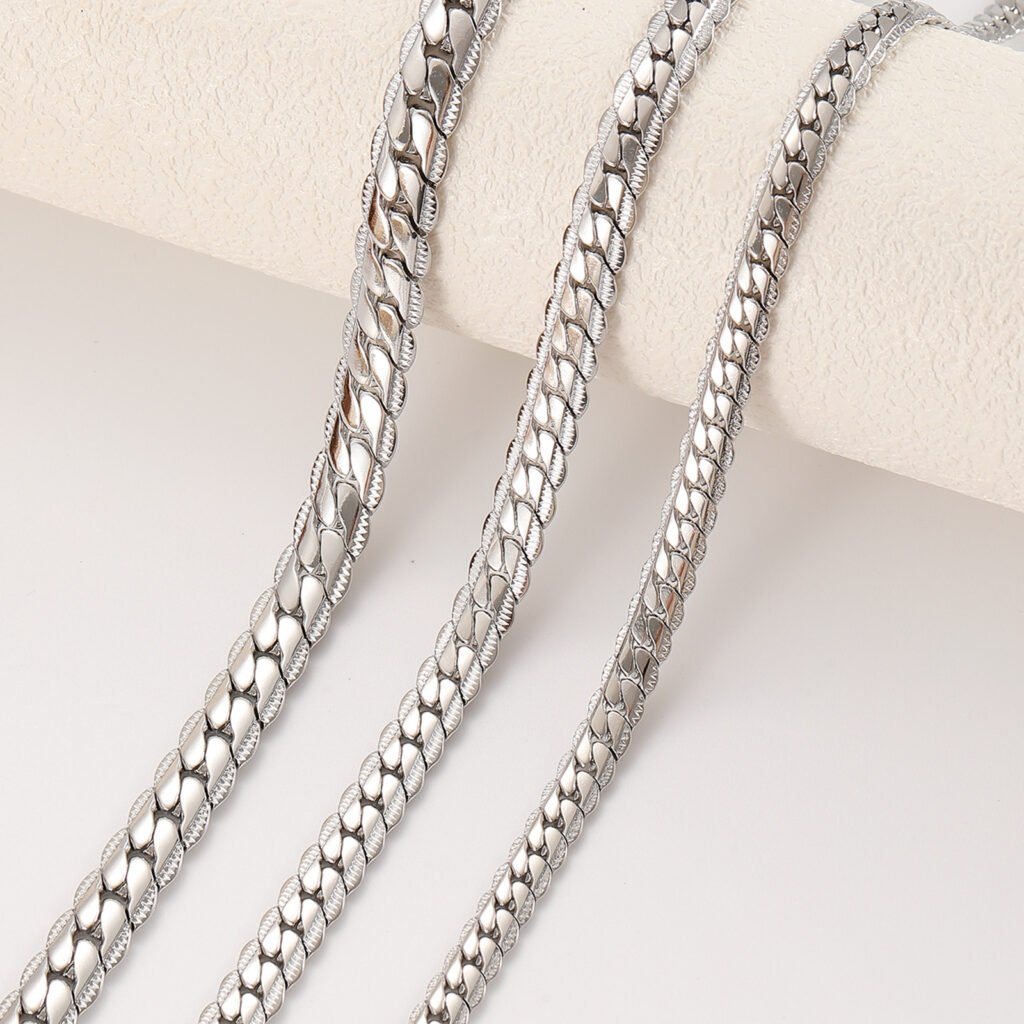
A denser NK variation with decorative embossed texture along the links.
How to Specify Density Clearly
When requesting a quotation or sample, use at least one of these methods:
- Send a clear reference photo
- Provide an approved physical sample
- Ask the supplier to confirm the wire diameter
- Request a close-up image from the front and side
- Compare the open space between links at the same chain width
Avoid using only words such as “tight,” “heavy” or “premium.” These descriptions can be interpreted differently by different suppliers.
4. Confirm How the Links Are Connected
Most standard Cuban chains use a regular sequence in which one link connects to the next link. This standard structure normally does not require a special note.
A double-link construction uses a more complex interlocking arrangement in which one link engages with two adjacent links. This creates a thicker, denser and more layered appearance.
In our factory terminology, double-link and double-woven are two expressions for the same construction. The example below is identified as a double-woven, six-side-ground Cuban chain. The name combines two separate specifications:
- Double-woven: the link construction
- Six-side-ground: the surface profile
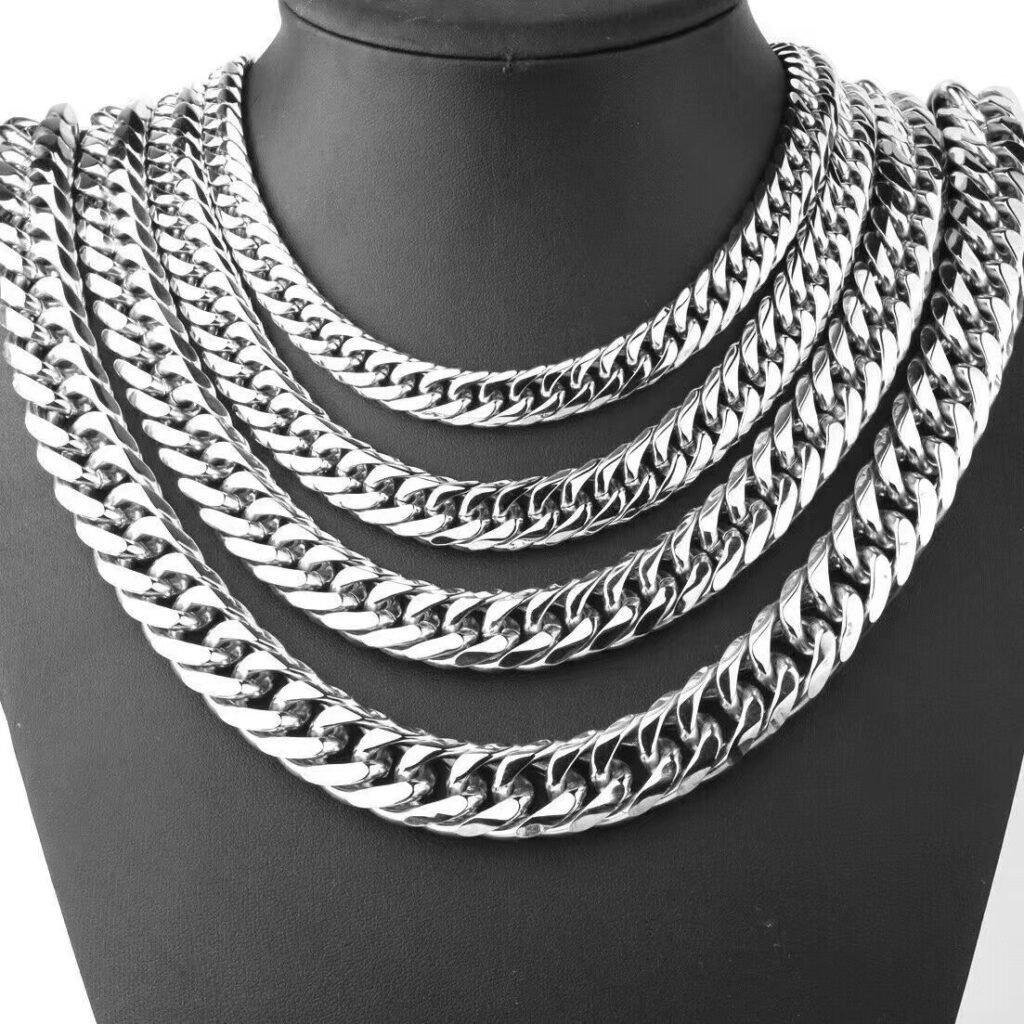
A double-woven construction combined with a six-side-ground surface profile.
Because factory terminology can vary, the safest method is to describe the actual connection rule and attach a close-up photo.
5. Identify the Link Pattern
Not every Cuban-style or curb-style chain uses links of the same length. The repeating pattern is another easy way to identify a variation.
Standard NK Pattern
A standard NK chain uses links of generally consistent length. The visual rhythm stays uniform from one end of the chain to the other.
3:1 NK or Figaro Pattern
A 3:1 NK uses a repeating sequence of three short links followed by one long link. In the international jewelry market, this structure is commonly known as a Figaro chain.
The Rio Grande jewelry chain guide also describes Figaro as one longer link alternating with several smaller links, commonly three to five. For this article, the pictured DOMI factory variation uses the specific 3:1 arrangement.
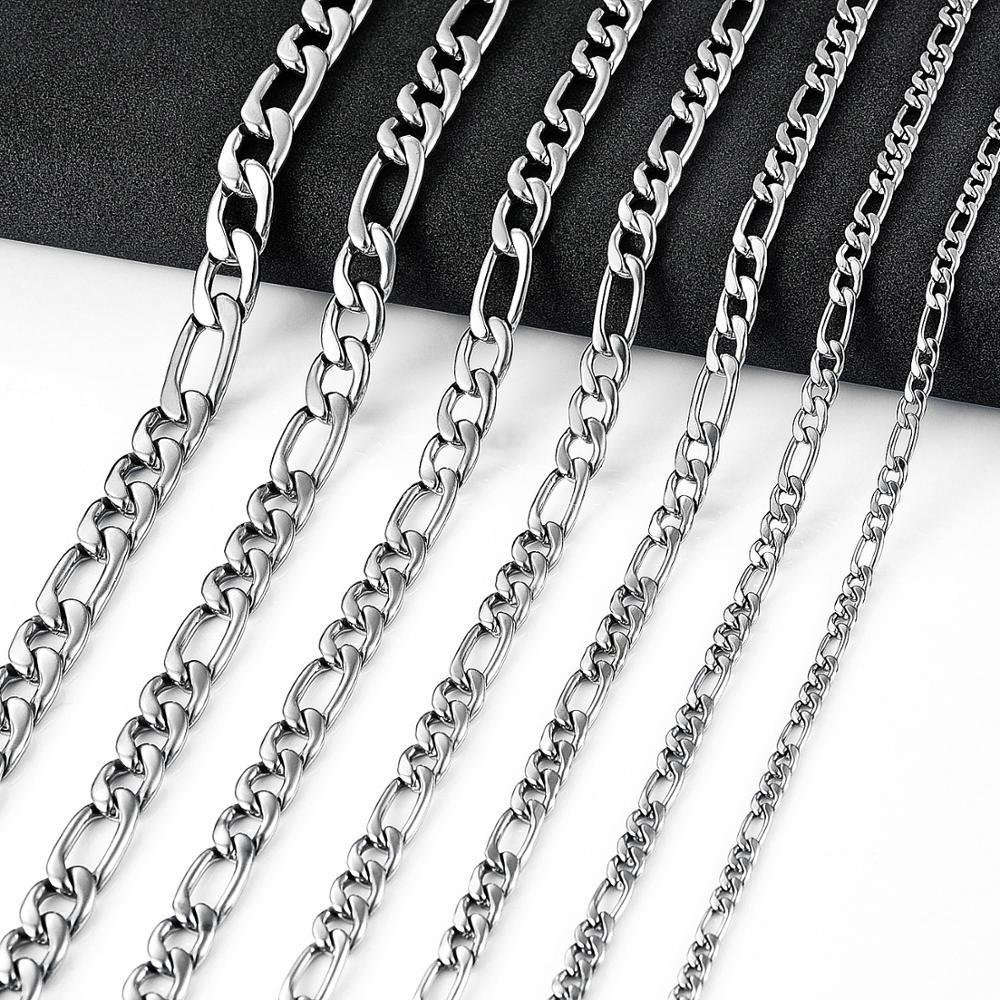
Three short links followed by one long link create the repeating 3:1 Figaro pattern.
How to recognize it: Do not focus on surface finish first. Follow the link sequence along the chain and look for the repeating short-short-short-long rhythm.
A Practical Cuban Chain Specification Checklist
Before asking a factory for a sample, quotation or bulk order, confirm:
- Product type: necklace or bracelet
- Width: for example, 6 mm or 10 mm
- Finished length: including the agreed measuring method
- Surface profile: rounded-face, two-side-ground, four-side-ground or six-side-ground
- Link density: open, medium or dense, supported by a photo or sample
- Link construction: standard or double-link/double-woven
- Link pattern: uniform, 3:1 Figaro or another repeating sequence
- Reference views: front, side and close-up images
Here is an example of a clearer sourcing request:
We need an 8 mm × 50 cm Cuban chain with a six-side-ground profile, dense links and a standard single-link construction. Please confirm the wire diameter and send front and side close-up photos before sampling.
This request gives the supplier much less room for interpretation than simply asking for an “8 mm Cuban chain.”
Frequently Asked Questions
Is Width Enough to Specify a Cuban Chain?
No. Width tells the supplier the overall size, but not the surface profile, density, wire diameter, link construction or repeating pattern. Add these details or provide an approved reference photo.
What Is the Easiest Way to Tell a Four-Side-Ground Chain From a Six-Side-Ground Chain?
Look at the side reflections. A four-side-ground chain has a more squared profile. A six-side-ground chain has additional beveled surfaces that create diagonal highlights and a more diamond-like outline.
Is “NK Chain” a Universal International Name?
No. NK is a useful factory term in our supply chain, but not every supplier or buyer uses it in the same way. Describe the chain as flat and open, then send a close-up photo.
How Should a Buyer Confirm Link Density?
Compare chains at the same width. Ask for the wire diameter and close-up front and side images, or send an approved sample. This is more reliable than using subjective words such as “tight” or “heavy.”
Final Advice for Professional Buyers
The most useful lesson is simple: classify Cuban chains by separate dimensions instead of relying on one product name.
Start with width and length. Then check the surface profile, link density, connection method and repeating pattern. When terminology may vary, use a close-up reference image and describe the visible structure.
This approach helps you communicate faster, compare quotations more accurately and reduce avoidable sample revisions.
If you are developing a Cuban chain collection, explore DOMI Jewelry’s stainless steel Cuban chain OEM options or review our OEM/ODM customization service. You can also contact our factory team with your target width, length and reference images.
In the next article, we will explain how to compare Cuban chains by material, manufacturing process and finish.