
When buyers inspect a stainless steel necklace or bracelet, the first thing they often notice is the shine. But a product can look attractive in a photo and still create problems after delivery.
Incorrect length, loose connecting rings, a difficult clasp, sharp edges or uneven plating can all lead to returns and customer complaints.
Based on more than ten years of factory experience, we have simplified the process into four practical checks. This stainless steel chain quality inspection checklist applies to Cuban chains, rope chains, Figaro chains, snake chains and many other chain-style necklaces and bracelets.
The goal is simple: confirm that the product matches the order, works correctly, feels comfortable and has a consistent appearance.
A Simple Four-Part Quality Check
Before accepting a sample or bulk order, check four areas:
- Specifications: Are the length and selected chain width correct?
- Connections: Are the links, connecting rings and clasp secure?
- Surface and comfort: Is the chain smooth, bright and comfortable against the skin?
- Plating color: Is the color correct, even and consistent across the batch?
These checks are easy to understand, but they cover many of the problems that can create after-sales risk.
1. Check the Product Specifications
Always compare the finished product with the purchase order and the approved sample before judging its appearance.
Check the Necklace or Bracelet Length
Length affects both fit and customer expectations.
As a general factory reference:
- For necklaces, a difference within 0.5 to 1 cm is normally acceptable.
- For bracelets, the difference should be controlled within 0.5 cm.
Bracelets require tighter control because a small difference can noticeably change how the product fits the wrist.
These are general production references, not universal rules. If the order, drawing or approved sample has a stricter requirement, the confirmed customer standard should be followed.
Buyers who are still deciding which size to order can also use our necklace length guide.
Understand How Chain Width Is Selected
For most standard chain necklaces and bracelets, width is selected from existing market specifications. Factories normally purchase standard chains rather than producing any requested width from zero.
The buyer should first choose an available chain style and width. During inspection, the factory must confirm that the correct standard chain was used.
If the ordered width and the actual product do not match, this is a material selection or order execution error. It should not be treated as a normal production tolerance.
For example, Cuban chains are available in several standard widths and surface styles. Our Cuban chain identification guide explains how buyers can distinguish them.
Know What Can Be Customized
After the standard chain is selected, most factory processing and customization happens in these areas:
- Necklace or bracelet length
- Clasp type
- Connecting rings and end components
- Logo tags or other accessories
- Polishing and surface finish
- PVD plating color
- Overall component matching
This is why buyers should confirm the base chain first, and then discuss the finishing and assembly details with the factory.
2. Check the Connections and Components
A chain is only as reliable as its weakest connection.
Look at the chain links, connecting rings, clasp and all assembly points. Each connection should be closed, secure and properly finished.
Use a Simple Hand-Pull Test
For a normal order, a simple hand-pull test is usually enough to find an obviously loose connection.
Gently pull the chain at the connection points and check whether any link, ring or component opens, moves out of position or feels unstable.
For a large-volume order, a tensile test may be added when required. The force, test position and pass standard should be agreed before production. Buyers and suppliers should not apply an invented test value after the goods are finished.
Test the Clasp
Open and close the clasp several times.
The clasp should move smoothly and should not feel stuck or difficult to operate. A beautiful chain with a difficult clasp can still create a poor customer experience.
Clasp function is especially important for bracelets because the wearer may need to operate the clasp with one hand.
Inspect the Connecting Rings
Check two details:
- Is the joint flat?
- Has the joint been welded?
A raised or rough joint may scratch the skin. An unwelded or weakly welded ring may open during wear and cause the necklace or bracelet to fall off.
Good connection work should be secure and comfortable at the same time.
3. Check the Surface and Wearing Comfort
Necklaces and bracelets are worn directly against the skin. Surface quality is therefore not only a visual issue.
Look at the Overall Brightness
The chain should have a clean and consistent finish. Check whether the polishing looks even across the front, sides and connection areas.
Brightness alone does not prove that a product is high quality. However, uneven shine, visible polishing marks or poorly finished inner areas can show that the surface work is incomplete.
Different finishes also create different appearances. Buyers can compare common methods in our stainless steel jewelry finishes guide.
Use Your Hand to Check for Sharp Areas
Run your fingers gently along the chain, clasp and connecting rings.
The product should not feel sharp, rough or uncomfortable. Pay attention to:
- Link edges
- Welded joints
- Connecting-ring openings
- Clasp corners
- End components
Burrs, sharp points and rough surfaces may scratch the skin or catch on clothing. These problems can easily become returns or customer complaints.
For a wearable product, comfort is part of quality.
4. Check the Plating Color
Buyers can check whether the color looks even and attractive, but they normally cannot judge the complete plating process by appearance alone.
What Buyers Can Check Visually
Inspect the entire necklace or bracelet instead of looking at only one area.
Check for:
- Uneven color
- Obvious dark or light areas
- Different colors between the chain and components
- Visible color differences within the same batch
- An unattractive or incorrect gold tone
The clasp, connecting rings, logo tag and chain body should look visually coordinated.
What Buyers Cannot Confirm by Appearance Alone
The finished color does not tell the full story. Plating quality is also affected by:
- Electroplating or PVD vacuum plating
- Coating thickness
- Surface preparation before plating
- Equipment and process settings
- Color adjustment
- The plating factory’s experience and consistency
Two products may look similar when they are new but perform differently over time.
For gold stainless steel jewelry, buyers should confirm real-gold PVD plating with the supplier. PVD is normally the more suitable direction when the product requires better color durability.
However, the word “PVD” is not a complete quality guarantee. Different plating factories can produce different results in color appearance, coating quality and batch consistency. Our detailed guide explains how PVD plating works in stainless steel jewelry.
Common Basic Colors
Natural steel is the original stainless steel color. It is not a plating color.
The three most common basic plating colors are:
- Gold
- Rose gold
- Black
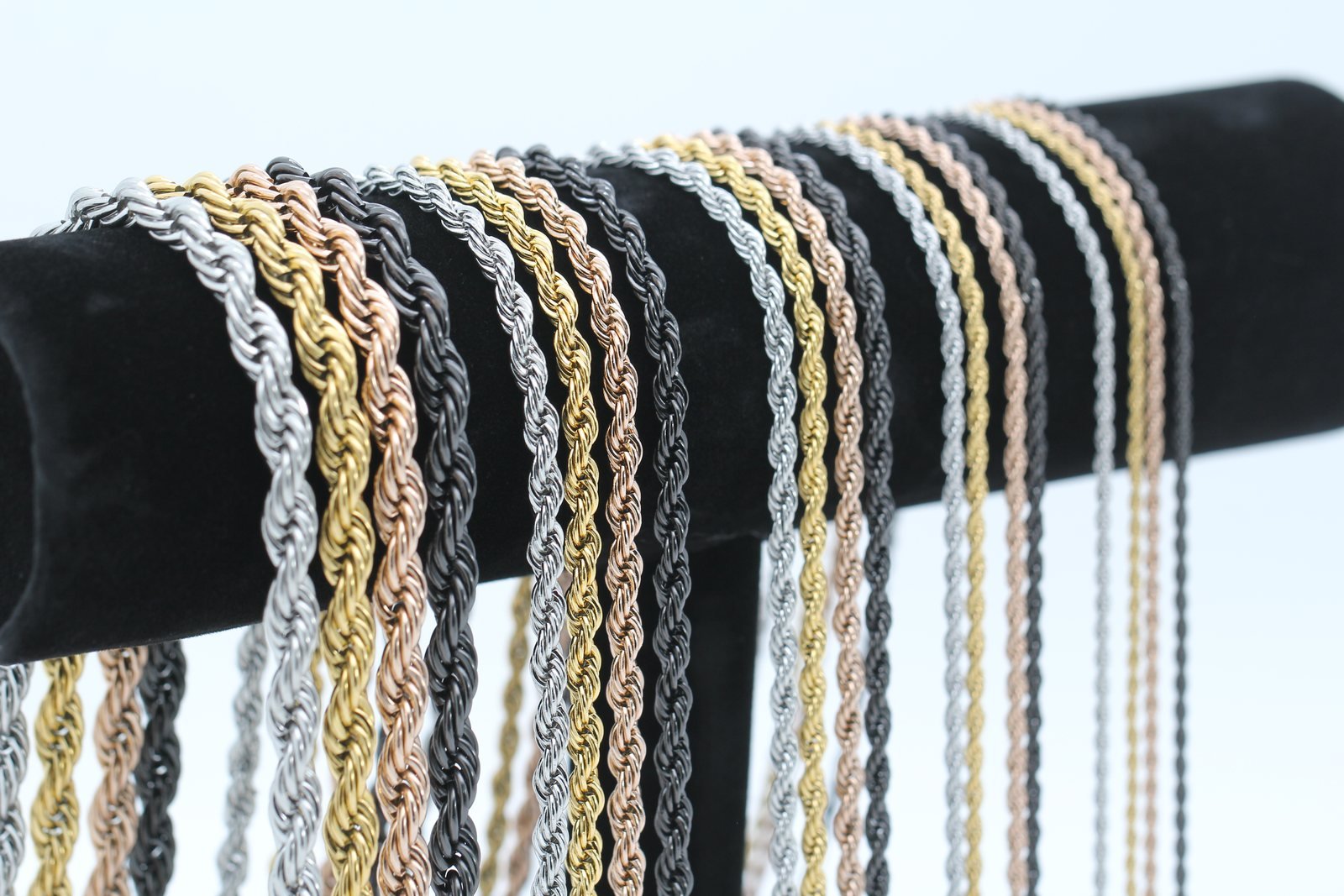
Other visible options can include blue and rainbow finishes.
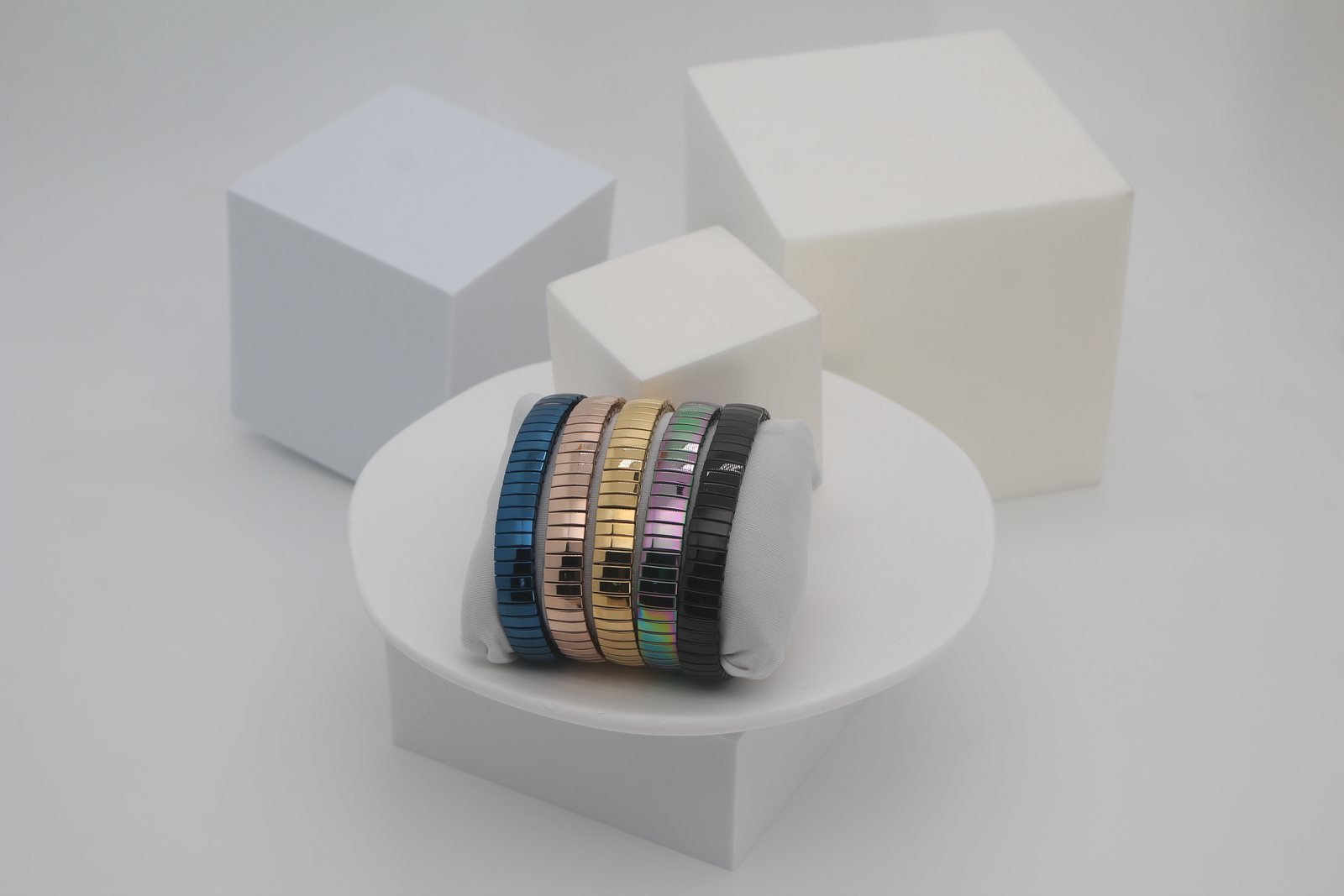
Most buyers use established color options. Special custom color adjustment normally requires a very large order quantity, so it is not a standard reference for normal purchasing.
Confirm the Gold Tone
Common gold color standards include:
- 14K gold color
- 18K gold color
- 24K gold color
The required color should be written clearly in the order.
These terms describe the requested plating color or plating requirement on a stainless steel product. They do not mean that the whole necklace or bracelet is made from solid 14K, 18K or 24K gold.
During inspection, check whether the finished product matches the ordered gold tone and whether the color is consistent across the chain and components.
Why an Experienced Factory Matters
Reliable plating quality depends partly on the factory’s supply chain.
An experienced jewelry factory has normally worked with different plating suppliers over many years. It learns which partners can provide stable colors and which processes often create problems.
Unstable suppliers are gradually removed. Long-term plating partners are retained because their results are more consistent.
This does not mean that every PVD order is automatically perfect. It means an experienced factory is better positioned to select suitable plating partners, communicate color requirements and control repeat orders.
When evaluating a supplier, do not ask only, “Is it PVD plated?” Also ask how the factory controls plating quality and batch color consistency. Our guide on how to find jewelry suppliers provides more supplier-selection advice.
Stainless Steel Necklace and Bracelet Inspection Checklist
| Inspection item | What to check | Main risk |
|---|---|---|
| Necklace length | Compare with the order and approved sample | Incorrect product specification |
| Bracelet length | Keep the difference within 0.5 cm unless another standard was confirmed | Poor wrist fit |
| Chain width | Confirm the correct standard market specification was used | Wrong material selection |
| Chain links | Check that links are closed and stable | Opening or breakage |
| Clasp | Open and close several times | Difficult daily use |
| Connecting rings | Check flat joints and welding | Scratching or product loss |
| Surface finish | Check brightness, polishing and visible marks | Poor appearance |
| Wearing comfort | Feel for burrs, sharp points and rough areas | Skin discomfort and returns |
| Plating color | Check the ordered color and batch consistency | Color complaints and inconsistent stock |
Questions to Confirm Before Bulk Production
Before placing a bulk order, confirm:
- Which chain style and standard width will be used?
- What necklace or bracelet length is required?
- Which clasp and connecting components will be installed?
- Does the order require natural steel, gold, rose gold or black?
- For gold products, is the required tone 14K, 18K or 24K color?
- Will real-gold PVD plating be used?
- Is a simple hand-pull test enough, or is a tensile test required?
- Are there any stricter dimensional or testing requirements?
Writing these details into the order is easier than resolving a quality disagreement after production.
Final Thoughts
Stainless steel chain quality inspection does not need to be complicated.
Start with four questions:
- Is the specification correct?
- Are the connections secure?
- Is the product smooth and comfortable?
- Is the plating color consistent?
These simple checks help buyers reduce the risk of incorrect sizes, loose connections, difficult clasps, sharp surfaces and uneven colors.
The purpose of inspection is not only to find defective products. It is to protect the customer experience, reduce after-sales problems and build a more stable jewelry collection.
Frequently Asked Questions
What length difference is acceptable for stainless steel necklaces?
As a general factory reference, a difference within 0.5 to 1 cm is normally acceptable. A stricter order specification should take priority.
What length difference is acceptable for stainless steel bracelets?
The difference should normally be controlled within 0.5 cm because bracelet fit is more sensitive.
Can buyers customize any chain width?
Normally, no. Most standard chains use existing market width specifications. Buyers select from available chain styles and widths, while factories customize length, components, polishing, plating and assembly.
Can buyers judge PVD quality by appearance?
Not completely. Buyers can check color and uniformity, but they cannot reliably confirm coating thickness, surface preparation or process stability by appearance alone.
What are the most common colors for stainless steel chains?
Natural steel is the original material color. Gold, rose gold and black are the most common basic plating colors.
Discuss Your Stainless Steel Chain Order with DOMI Jewelry
DOMI Jewelry manufactures OEM and ODM stainless steel necklaces, bracelets and chains in Dongguan, China.
When requesting a quotation, please provide:
- Chain style
- Standard width
- Necklace or bracelet length
- Plating color
- Order quantity
- Clasp and accessory requirements
- Logo or packaging requirements
Email: vivian@domijewelry.com
WhatsApp: +86 13717184558
Website: https://domijewelry.com